"But, really, why does anyone create? You feel a... a restlessness inside, a need to make something new, something no one has ever seen before. You want to add to the beauty and the richness of the world with a gift, an offering that is uniquely yours. It's an act of selfishness and generosity, all rolled into one."

-- Bruce Coville,
The Last Hunt

Sunday, October 10, 2010

Needlecraft Magazine 1916-1921, Part III

Yes, it's Part 3. I know if there are two posts in one day, it can be easy to miss the first one. So in case you didn't see it, I did post Part 2 yesterday. Today I'm covering the two issues I have from 1919, February and November.

From the February issue there was only one page that interested me. At the top is a tatted baby bonnet, and at the bottom a vandyke border.


If this looks familiar, it is the same border that was in the April 1916 issue. Now the designer has worked out how to turn the corner. It's funny, considering how many issues I'm missing, that I should have the two that both have this border.

On to the November issue.


Sometimes you could mail-order the materials to make the items shown, as with this hen-and-chicks hanky. If I understand it correctly, you could buy the embroidery pattern to stamp or transfer onto your own fabric, or you could buy the hanky with the pattern already on it. For 57 cents, you could get the hanky, embroidery floss, and tatting thread.

Interestingly, it does not say that the tatting instructions come with it, nor are they given anywhere in the magazine. They must have just assumed that everyone knew how to make hen-and-chicks. If you didn't, of course, you could always write to the editor, and she would tell you; I've noticed a lot of the letters to the editor are requests for patterns.

Yoke or collar. This pattern doesn't do so much for me.


This would be the same Anne Orr who also wrote several tatting books and invented the split ring.

And I know you're all planning to serve a Crown of Roast Pork for Thanksgiving, right?

Saturday, October 9, 2010

Hey, I Won!

Wow! I won LadyShuttleMaker's Mondo Monday Giveaway! I'll be getting two issues of The Workbasket, plus a skein of Sherry's gorgeous silk HDT in "Fuschia". I've already worked with this colorway in cotton, so I know it's pretty-- can't wait to see it in silk.

Thanks, Sherry!

Needlecraft Magazine 1916-1921, Part II

Do you like my new look? I saw the lace and had to have this background. How are the colors? Easy to read?

My hit counter passed 5000 yesterday. My 100th post is also right around the corner. We all know how tatting bloggers celebrate such milestones, so watch this space!

Now, on to Needlecraft. Today I will look at the December 1918 issue.

This is the bottom of a crocheted candleshade. I think it is intended to resemble tatting.


A doily sent in by a reader. Notice that the outer round is hen-and-chicks. It's a perennial favorite.

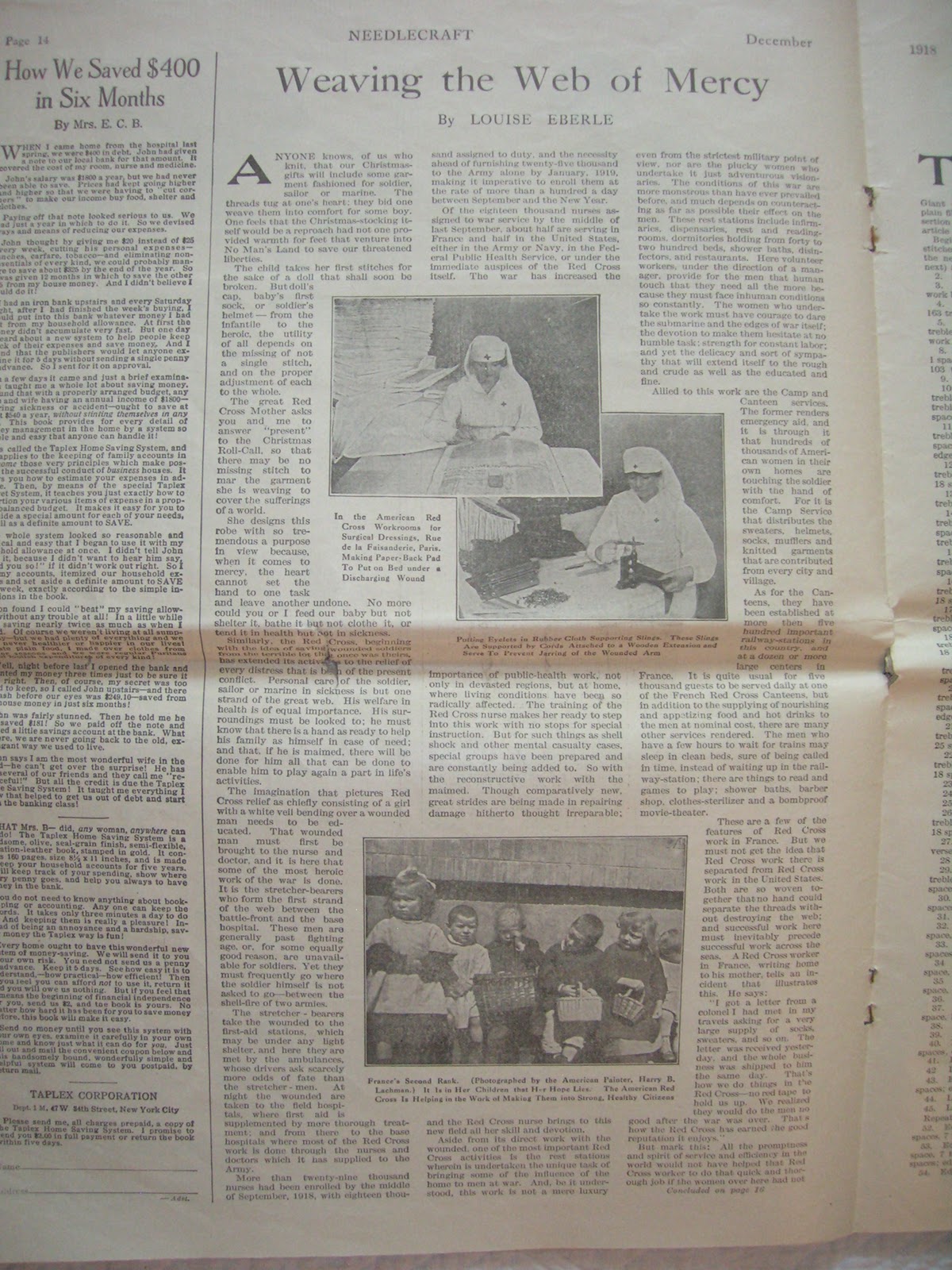
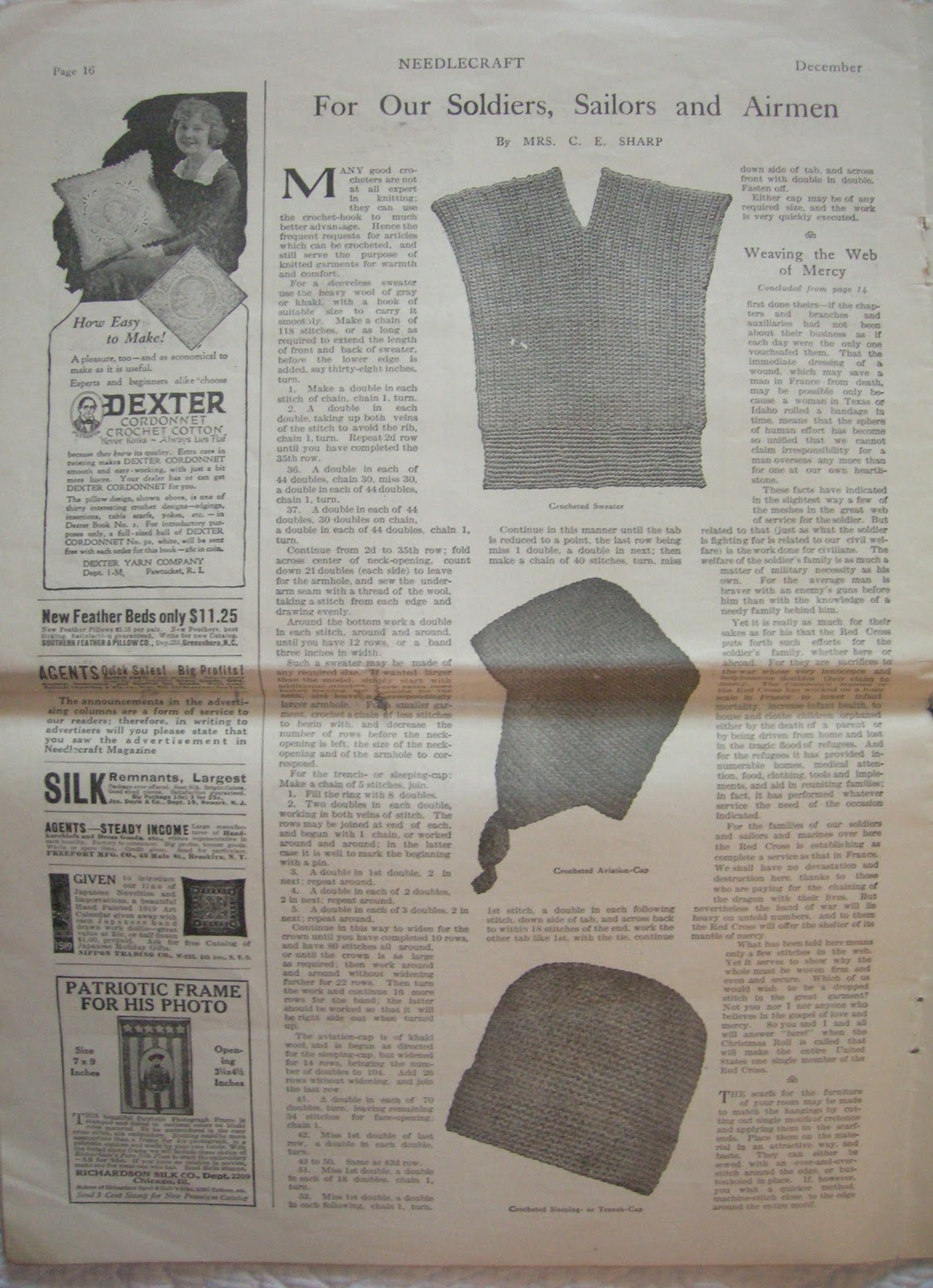
This issue-- remember, December 1918-- contains a lot of material on the War Effort and supporting the soldiers. It's interesting that the issues from 1916 and 1917 don't have this, though it may be that the two issues I have are not representative of those years. More interesting is the timing of the content of this issue. The magazine must have gone to press long before the actual issue date. Not that there wouldn't still have been soldiers in Europe in December (it was still another six months till the Treaty of Versailles), but theoretically they shouldn't have been getting shot at so much. Anyway, I'm pretty sure this magazine would have been celebrating the armistice if they had known about it at press time.


Another cultural note is that back then, articles about Christmas appeared in the December issue, not the July issue.

This article describes the work of the Red Cross and exhorts readers to knit items of clothing for the soldiers.
 
Patterns to crochet for soldiers. At the bottom left is also an ad for a patriotic picture frame for the photo of your soldier family member.

Even purely decorative patterns were inspired by patriotism and pride in the service members, as seen in this filet crochet pattern.

The next batch of pictures will have more tatting-related content. But part of the interest of old magazines is in looking at the historical context and how it affected people's daily lives, so I wanted to get this in.

Friday, October 8, 2010

Needlecraft Magazine 1916-1921, Part I

The other day I remembered some old Needlecraft magazines my Grandma gave me when I first took up tatting.

She told me they had come from either her mother or her grandmother. However, one of the magazines has her Aunt Mertie's (my great-great-aunt) name written on it, so I'm going to guess that she was the one with the subscription. Regardless, they would undoubtedly have been shared around the family; and anyway, to hear Grandma tell it, anything that belonged to Mertie pretty much also belonged to Mertie's mother (Grandma's grandmother, are you keeping up with this?), at least in her own opinion.

There are about nine issues here. I say "about" because several of them are missing a few pages, while there are a few that only have a few pages left. My family keeps everything forever, but our archiving skills leave a bit to be desired. The earliest issue is April 1916 and the latest is January 1921, with a single page also from a 1925 issue.

Every issue has several tatted pieces in it, which I will start showing you just as soon as I quit rambling. There's also a fair amount of crochet, some knitting, embroidery, sewing/ fashion information, and a bit of the kind of heartwarming if somewhat silly short fiction that women's magazines used to publish. Some of the ads are amusing, too. As far as I know, none of my ancestors tatted (and Grandma would have told me if they did). They would have been more interested in the crochet and sewing.

These magazines are all falling apart, so I won't put them on the scanner. Instead, I have taken photos of the interesting bits. Most of it you won't be able to read, but it will show you what was there. There's a lot, so I'm going to break it up into tentatively five posts over the next several days. I'll take the issues in chronological order, though I'll sometimes skip around a bit within an issue.

 So, beginning with April 1916:


Vandyke Border


Baby Slippers. I guess the word "booties" hadn't been coined yet.


Collar. What I'm noticing (and have noticed with other older patterns) is that they had a lot more patience with hiding ends back then than many of us do today.

This is the first paragraph of the collar pattern. Each of the round motifs had some woven needlework in the center, and this paragraph tells you how to do it.

This has nothing to do with tatting. I just laughed at the idea of sewing bags for your lettuce and celery. Then I realized they didn't have crisper drawers back then, so they did what they could.

This snippet was sent in by a reader in the January 1917 issue. I think the first sentence is supposed to describe tatting over tails. The third sentence describes a precursor to the magic thread trick. You would have had to tat pretty loosely to get a crochet hook in there, though.

All of these are in the public domain now, so if you'd like a closer photo of any of the patterns, e-mail me and I'll do my best. It is hard to get a good photo of text, though. Tomorrow I'll post from the December 1918 issue.

Thursday, October 7, 2010

Kitty in Bathtub

Squijum's latest thing is playing in the bathtub. He likes the way the toys roll around in there. It's also the only place where he still chases his tail, although you don't get to see that in this video.

Wednesday, October 6, 2010

Snowflakes

A new design in progress is never a pretty thing.

I knew I wanted to make a snowflake starting with a spiral center, but I wasn't quite sure where I was headed from there. The first try, at the top, had too many rings around the edge of the spiral, plus I wasn't doing so well with the 3-ring clusters in the next round. On the next attempt, I had the general shape of the thing right, although some stitch counts needed to be adjusted. Then on the last round, I could see after the first section that it wasn't working, so I did something different with each subsequent repeat just to see what I liked. On the third one, at the bottom, I had something that almost worked, except that the last round still didn't lie flat, and also it was just too round for a snowflake.

Jon and Jane make designing look so easy, maybe because they have enough sense not to post their failures.

Finally, I got it. I give you "Ice Crystal":

 It needed something to break up the long chains on the outer round, and regular rings just weren't working, so I finally hit on split rings. Also, thanks to the magic of split rings and SCMR's, this whole flake can be worked without cutting and tying. This is done in the "Icicle" colorway by LadyShuttleMaker. You would think I would have enough sense not to design in expensive HDT, but each time I really thought I had it. That'll learn me.

I've made a couple of other snowflakes lately, but these designs are older. 


If you've followed my blog for a while, you've seen this design before. It's "Angels in the Snow", for which I had a giveaway contest a few months back for the best name (the winner was Linda). This time I've done it in LadyShuttleMaker's "Winter Haze". And yes, that's a cat hair.


Finally, a design you haven't seen before, but which I did a couple of years ago for a round robin snowflake exchange. This was my first real attempt at designing. I call it "Starflower" because I can make it look more like a star or more like a flower, depending on how pointy I make the points when I block it. This is Yarnplayer's "Snowflake" thread. The scan really doesn't do the colors justice.

This brings up the question, is it really a snowflake if it's not white? Well, no, it's a 6-pointed motif. But these are all winter-inspired colorways, and anyway, we've gotten so much in the habit of calling any 6-pointed motif a snowflake, why stop now? Just don't eat the yellow snow.

Saturday, October 2, 2010

Vintage Hankies

I've had these for a couple of years now, and I just realized I've never posted them. I picked them up in a couple of local antique shops.


On this one, the flowers, which are hand painted, are actually more interesting than the tatting, but I was in the mood to buy anything tatted that day. I always wonder about the history of things. In this case, I'm curious about the fact that these are "Alaska Wildflowers", purchased in an antique shop in New Mexico. Perhaps a souvenir from somebody's vacation? Or a commemoration of Alaska's statehood in 1959?


The flowers in the corners of this one are hand embroidered. Who knows whether the embroidery and tatting were done by the same person, but one does wonder why no attempt was made to match the tatting thread to any of the colors in the embroidery (or vice-versa, depending on which was done first). Both the embroidery and the tatting are very nicely done, though.


A hen-and-chicks edging done in a lovely pink and blue variegated thread. The fact that the "All Linen, Made in Ireland" sticker was left on makes me think that this was made as a gift; the maker left the sticker on to let the recipient know that she was getting quality goods, and then the recipient never took it off because the hanky was "too nice to use". That's my story and I'm sticking to it. Does anyone know what "R.N. 16061" means?

Have I mentioned lately how cute Squijum is?